The Elephant's Tryst with Capitalism
In 1991, India pledged its gold to avert a payments crisis. Three decades on, it is the world's fifth-largest economy.
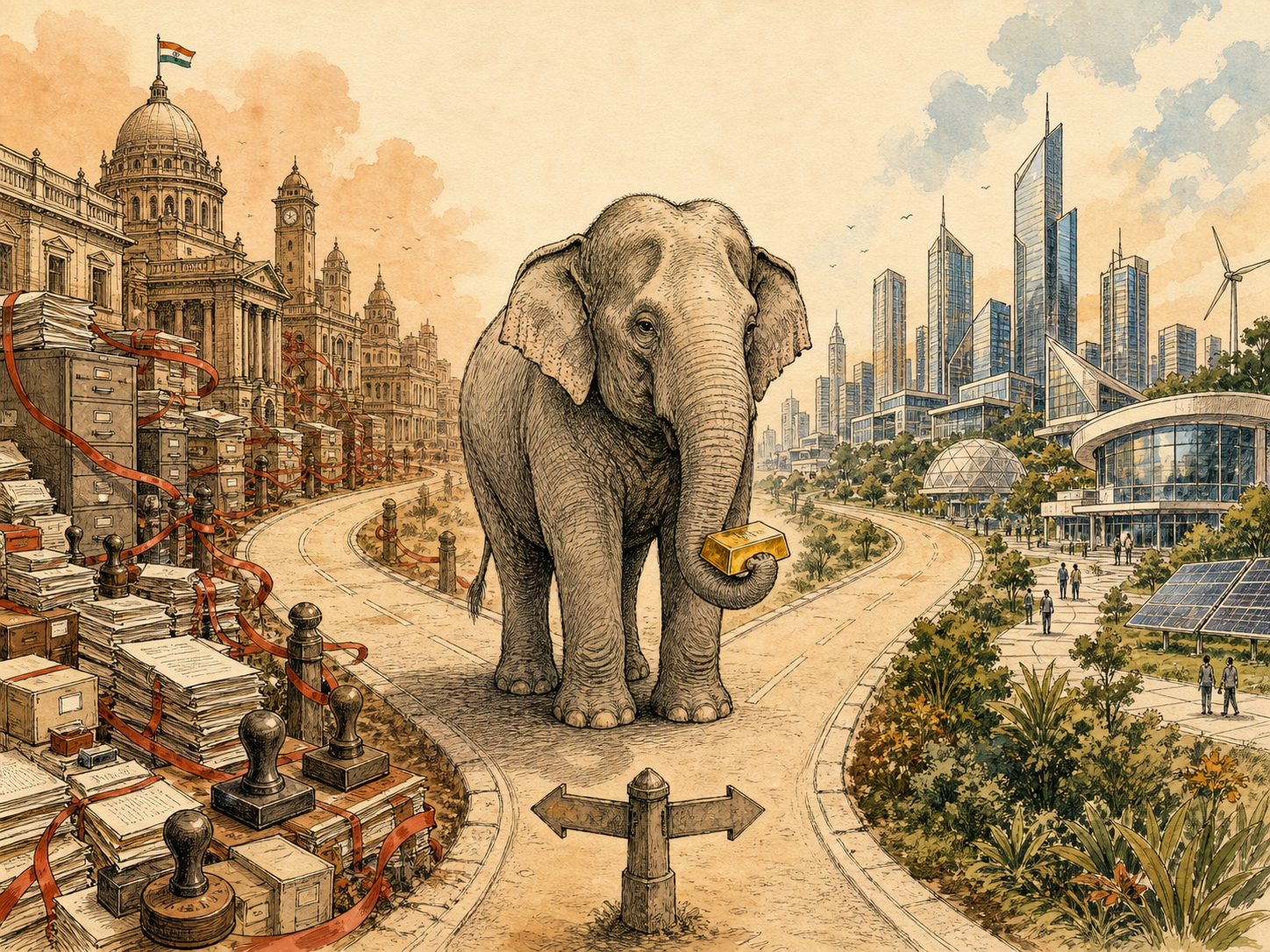
For most of its post-independence history, India grew at roughly 3% a year — the “Hindu rate of growth,” as economist Raj Krishna named it in 1978 — while inflation regularly ran in double digits.1 Food insecurity was chronic; India imported wheat through the 1960s and relied on US PL-480 aid shipments to feed its population.2
The crisis came to a head in 1991 with a balance of payments collapse that left India with foreign exchange reserves sufficient to cover barely three weeks of imports. What followed produced one of the more striking images in modern economic history: dozens of Reserve Bank of India vans outside Indira Gandhi International Airport, carrying physical gold reserves to be pledged with the Bank of England in exchange for emergency foreign exchange.3
In lieu of an outright IMF bailout, India was compelled to liberalise — dismantling the licence raj that had governed its economy since independence and opening its services and manufacturing sectors to competition.
The results were not immediate, but they compounded. India had an enormous stock of STEM-educated talent with few productive outlets: a handful of private sector roles and the civil service. Liberalisation gave that talent somewhere to go. Infoedge (1996) and Mindtree (1999) were products of the new environment. Infosys, founded in 1981, predated the reforms but scaled dramatically after them, eventually becoming a bellwether for the Indian IT services industry. A similar dynamic played out in pharmaceuticals, where Indian generics manufacturers built export businesses — particularly into the United States — that now supply a significant share of the world’s essential medicines.4
What started as labour-cost arbitrage matured into genuine capability. Indian IT services companies today compete on the quality and scale of their delivery, not simply on price.
The second wave followed the 2008 recession: Zomato (2008), Zerodha (2010), Bigbasket (2011), Swiggy (2014) — a cohort focused on the Indian consumer rather than the export market. These companies built category-defining products for a domestic audience that, for the first time, had smartphones, cheap mobile data, and enough disposable income to pay for convenience.
Three decades on, India is the world’s fifth-largest economy by nominal GDP and the third-largest by purchasing power parity.5 That transformation was not inevitable, and it was not smooth — it was forced by a crisis and shaped by a series of contested, partial, ongoing reforms. The 1991 liberalisation was a turning point, not a destination. The economy that emerged from it is still being built.
-
Raj Krishna coined “Hindu rate of growth” in a 1978 paper presented at a conference in Delhi. The phrase described India’s ~3.5% average GDP growth rate from the 1950s through the 1970s. For inflation data, see RBI Handbook of Statistics on Indian Economy, various years.
-
India received US PL-480 (“Food for Peace”) wheat shipments from the mid-1950s through the late 1960s. See Francine Frankel, India’s Political Economy (2005).
-
The gold pledge is documented in detail in Jairam Ramesh, To the Brink and Back: India’s 1991 Story (2015). India pledged 67 tonnes of gold to the Bank of England and Bank of Japan.
-
India accounts for approximately 20% of global generic medicine exports by volume. Indian Pharmaceutical Alliance / IQVIA data.
-
World Bank national accounts data, 2024; IMF World Economic Outlook, 2024.