The Productivity Paradox, Again
Solow said you could see the computer age everywhere but in the productivity statistics. AI is no different — yet.
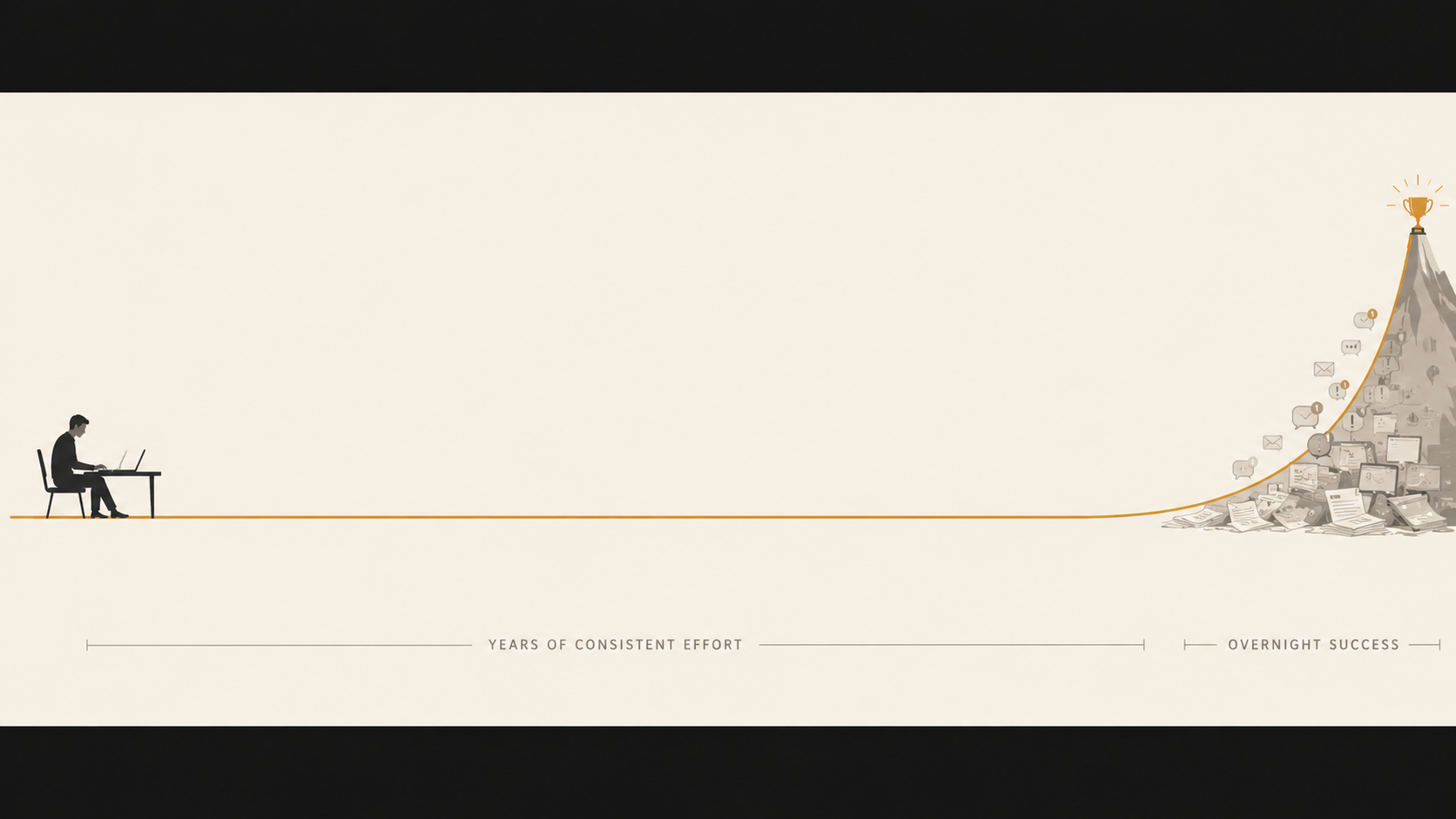
In 1987, Nobel laureate Robert Solow wrote: “You can see the computer age everywhere but in the productivity statistics.” The observation became known as the Solow paradox. It took roughly a decade to resolve: computers were genuinely transformative, but the productivity gains only materialised once organisations restructured themselves around the technology rather than simply adding it on top of existing processes.
The sentence is worth reading again now.
The investment is real. The gain is not yet.
Between 2023 and 2025, major technology companies accelerated AI infrastructure spending at a pace with few historical precedents. In 2025 alone, Alphabet, Amazon, Microsoft, and Meta committed over $350 billion to data centres and GPU capacity.1 In Q4 2025, 331 S&P 500 companies — 68% of those reporting — mentioned artificial intelligence on earnings calls, a ten-year high.2 The technology is everywhere.
US nonfarm business sector labour productivity rose 2.3% in 2024 — roughly in line with its post-pandemic average.3 The Bureau of Labor Statistics notes that productivity has remained above its pre-pandemic trend since 2022, an improvement over the sluggish 2010s. But there is no step change, no visible inflection, attributable to AI adoption at the aggregate level.
The investment is real. The aggregate gain is not yet in the data.
Why this pattern keeps recurring
Erik Brynjolfsson, the economist who studied the productivity paradox most closely, identified the mechanism. He called it the “productivity J-curve”: technology investment rises sharply at first, but measured output lags, because organisations need to reorganise around new tools before extracting value from them. Productivity appears to dip before it climbs.4
The historical precedent he returns to is electrification. Electric motors became commercially viable in the 1880s. US manufacturing productivity didn’t respond meaningfully until the 1920s — a lag of roughly 30 years. The delay wasn’t because electricity didn’t work. It was because factories initially replaced their central steam shaft with a single electric motor, maintaining the same layout. Only when engineers redesigned factory floors around distributed individual motors — fundamentally changing how space, labour, and workflow were organised — did output per worker rise sharply.5
The lesson isn’t that the technology was oversold. It’s that realisation requires reorganisation, and reorganisation takes time and carries costs that don’t appear in the immediate productivity statistics.
Where AI sits in that timeline
Generative AI tools became widely available to knowledge workers in 2023. Individual productivity gains — measured in controlled studies — are genuine. Programmers using AI assistants complete tasks roughly 55% faster in controlled experiments;6 legal and analytical workflows show gains in the 25–40% range in similar settings.7
But controlled studies measure what a tool can do for an individual. Aggregate productivity statistics measure what an economy does with it. The gap between those two is the reorganisation problem Brynjolfsson identified: the complementary investments in training, process redesign, and organisational restructuring that haven’t yet been made at scale.
Acemoglu (2025) estimates aggregate total factor productivity gains from AI of at most 0.66% over the next ten years — modest relative to the investment and the rhetoric surrounding it.8 His argument isn’t that AI doesn’t work; it’s that the tasks where AI currently performs well represent a smaller share of total economic output than the headlines imply. A significant fraction of hours worked involve physical presence, judgment under uncertainty, or interpersonal coordination — domains where AI’s current contribution is limited.
The uncomfortable parallel
If electrification is the right analogy, the productivity gains from AI are structural rather than absent — they are waiting on the organisational changes that make them measurable. The 30-year lag in electrification reflected a real constraint: reorganising how work is done is harder than changing what tools are available. There is no obvious reason to believe that constraint has been repealed.
The Solow paradox was eventually resolved. Computers did lift productivity — measurably, substantially, durably. The resolution just took longer and looked different from what the initial wave of adoption suggested it would.
In 1987, Solow couldn’t see computing in the productivity statistics. In 2026, with AI tools installed in most knowledge-work environments, the same sentence applies. That is not evidence that AI won’t matter. It is evidence that it hasn’t compounded yet.
-
io-fund.com, “Big Tech’s $405B Bet: Why AI Stocks Are Set Up for a Strong 2026,” 2025; see also GlobalDataCenterHub, “The $400B AI Boom Is Real,” 2025. Figures reflect combined capital expenditure commitments by Alphabet, Amazon, Microsoft, and Meta for 2025.
-
FactSet, “More Than 65% of S&P 500 Earnings Calls for Q4 Cited ‘AI’,” January 2026. 331 of 485 reporting companies cited AI — the highest figure in ten years of FactSet tracking.
-
US Bureau of Labor Statistics, Nonfarm Business Sector Labor Productivity, 2024 annual figure. See also BLS, “Productivity and Artificial Intelligence,” bls.gov.
-
Brynjolfsson, E., Rock, D., & Syverson, C. (2021). “The Productivity J-Curve: How Intangibles Complement General Purpose Technologies.” American Economic Journal: Macroeconomics, 13(1), 333–372. NBER Working Paper 25148.
-
David, P. A. (1990). “The Dynamo and the Computer: An Historical Perspective on the Modern Productivity Paradox.” American Economic Review, 80(2), 355–361. Cited extensively in Brynjolfsson’s work on general-purpose technologies.
-
Peng, S., Kalliamvakou, E., Cihon, P., & Demirer, M. (2023). “The Impact of AI on Developer Productivity: Evidence from GitHub Copilot.” arXiv 2302.06590; Microsoft Research. In a controlled experiment (n=88), developers with Copilot completed a defined coding task 55% faster than the control group.
-
Dell’Acqua, F., McFowland, E., Mollick, E. R., Lifshitz-Assaf, H., Kellogg, K., Rajendran, S., Krayer, L., Candelon, F., & Lakhani, K. R. (2023). “Navigating the Jagged Technological Frontier: Field Experimental Evidence of the Effects of AI on Knowledge Worker Productivity and Quality.” Harvard Business School Working Paper 24-013. BCG consultants using GPT-4 completed tasks 25–40% faster and with higher quality scores. See also Brynjolfsson, E., Li, D., & Raymond, L. (2023). “Generative AI at Work.” NBER Working Paper 31161, examining AI-assisted customer support.
-
Acemoglu, D. (2025). “The Simple Macroeconomics of AI.” Economic Policy, 40(121), 13–58. NBER Working Paper 32487. Estimates TFP gains of at most 0.66% in aggregate over the next ten years, or approximately 0.064 percentage points of annual TFP growth. See also Atlanta Fed Working Paper 2026-04, “Artificial Intelligence, Productivity, and the Workforce.”