What AI Feels Like
The Gutenberg Press democratized knowledge. AI is doing the same for intelligence. The pattern is worth examining.
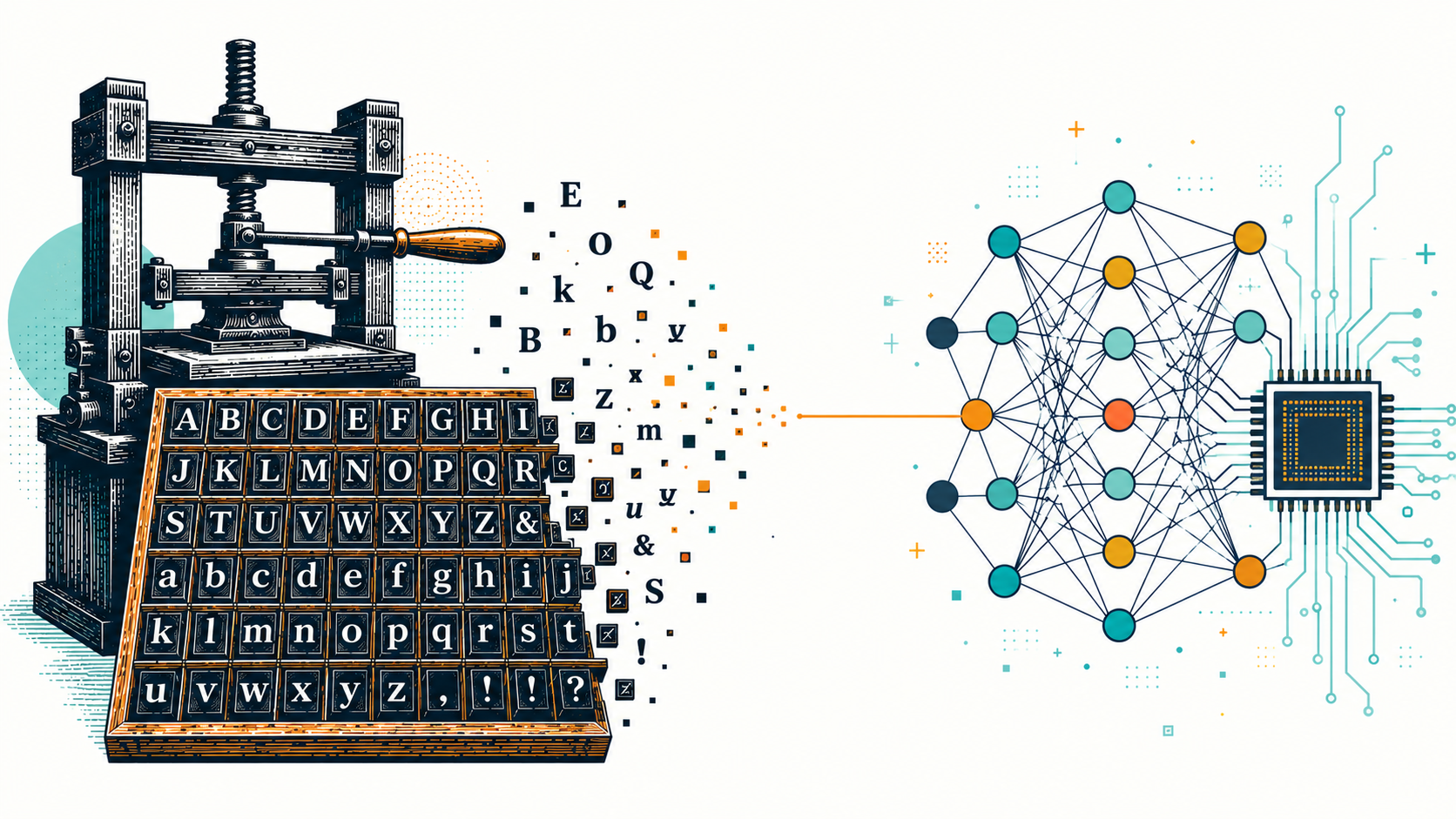
Working out what AI actually is — in the broad, structural sense — is harder than it looks. The analogies people reach for tend to be too small: the calculator automated arithmetic; the internet moved information faster. Neither quite captures what is happening.
The closest match might be the Gutenberg Press.
Before Gutenberg, writing was the province of specialist scholars — trained for years, producing manuscripts by hand, replicating knowledge at the pace of human effort. What humanity had figured out could not travel far or fast. The bottleneck was reproduction.
The press broke it. Knowledge could be copied cheaply, distributed widely, and standardized. Hand-copying introduced errors with every generation; a printed page had one source. Reading and writing spread as skills because knowledge itself had become abundant.
That is roughly what AI is doing to intelligence.
The gap between expert and novice is compressing across fields. Programming is the clearest example: two years ago, shipping a working application required months of specialized work; today a non-technical founder can get a prototype running in an afternoon. No-code AI platforms have cut typical development timelines by up to 90%, and non-developers now make up the majority of their user base. The same dynamic is playing out in legal research, medical diagnosis, financial modeling, and content production.
The Gutenberg parallel has a second half, though. The press democratized access to knowledge — it did not eliminate the value of judgment. Scholars who could interpret what was written, contextualize it, and apply it to novel problems became more valuable, not less. The commodity was the text; the premium was the reading.
The same split is emerging now. A 2023 Harvard Business School study — run with 758 BCG consultants — found that AI meaningfully improved performance on tasks within its capabilities, but consultants using AI on tasks outside that range were 19% less likely to produce the correct answer than those working without it. The researchers called this the “jagged technological frontier”: AI is not uniformly capable, and the boundary between what it handles well and what it handles badly is the crucial variable. That edge — recognizing when the output is confidently wrong, understanding what a client actually needs, anticipating the case the model could not foresee — is where value concentrates. That final judgment call is where expertise goes, not away.
Intelligence has been commoditized. The question worth sitting with is what that does to the price of wisdom.
The Gutenberg Press took more than a century to reshape the world it entered. The outcomes were not uniformly good. The same technology that enabled the Scientific Revolution also fueled religious wars; the press that spread literacy also spread propaganda. Democratization of a tool does not determine how the tool gets used.
The same ambiguity is present now. Lower barriers cut in every direction — for the skilled and the unskilled, for the well-intentioned and otherwise. We appear to be somewhere in that first chapter, with the ledger still open. The analogy is useful precisely because it does not tell us where this ends.