When Atoms Finally Compound
SpaceX's $2 trillion debut is the first serious test of whether physical technology can compound the way software has.
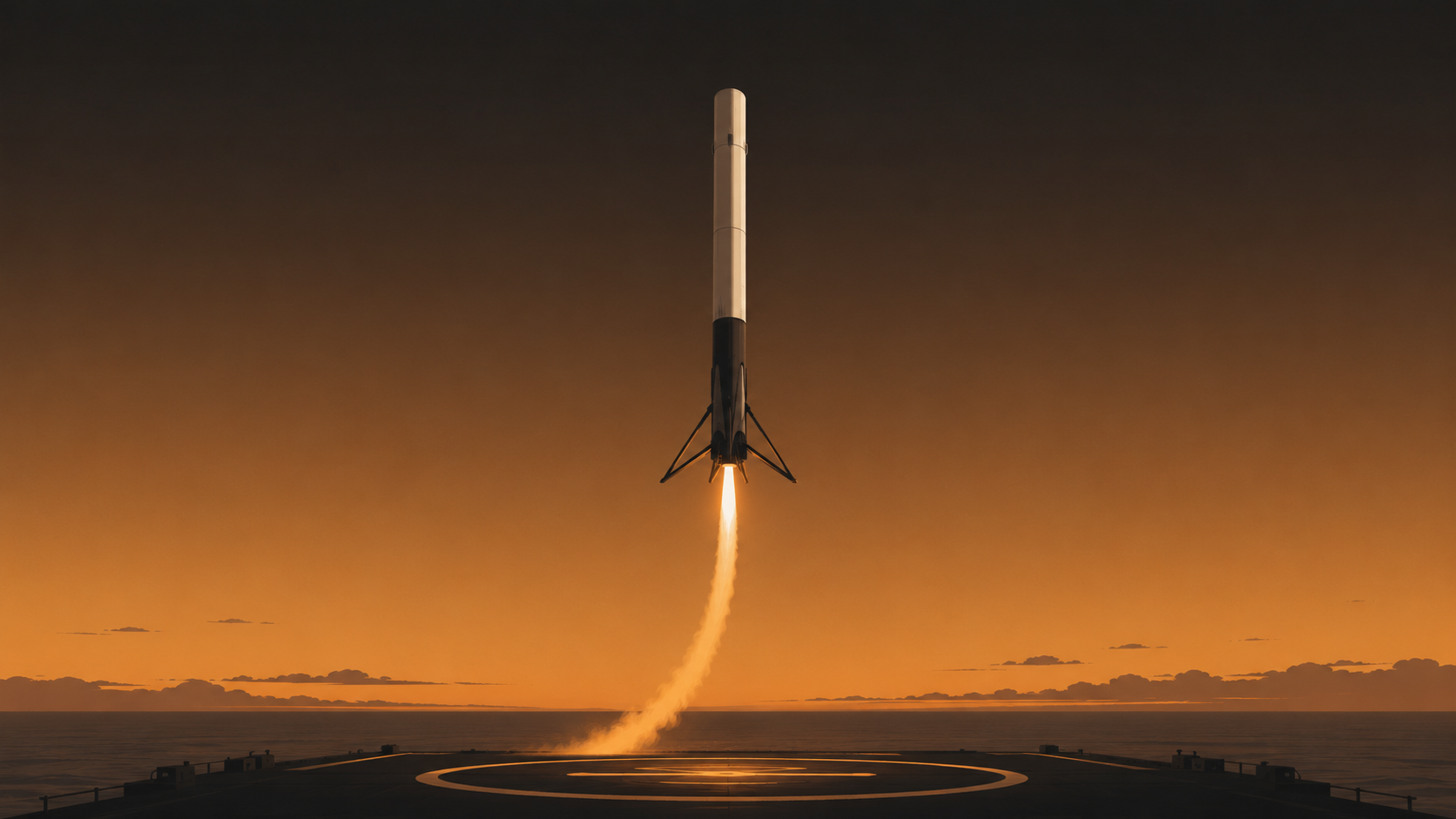
Earlier this year, this publication ran a piece arguing that software has compounded for fifty years while the physical world has largely not.1 Computing power doubles; airplanes fly at 1970 speeds. The reason: physical systems lack the economics of replication. A software product, once written, costs nearly nothing to copy. A rocket cannot — historically, each launch required a new vehicle, so the industry had no analogue to the compounding loops that made software scale.
SpaceX’s public market debut on June 12 is the most direct challenge to that thesis in the history of the space industry.
What reusability actually changed
The argument against physical compounding rested on marginal cost. When each unit of output requires essentially the same inputs as the last, there is no learning loop — no way for the cost of the thousandth unit to fall dramatically below the first.
Reusability is the attempt to change that for launch vehicles. If a rocket booster can be recovered and reflown, the amortised cost of each launch falls as the booster accumulates missions. SpaceX’s Falcon 9 has now completed over 260 successful re-flights across more than 315 booster missions.2 One booster — B1080 — completed its twelfth and thirteenth flights with a 13-day turnaround. The fleet average in 2024 was 25–30 days between missions.
The cost numbers follow. A reused Falcon 9 launch runs under $30 million; a new booster costs roughly $62–70 million.3 In 2025, SpaceX accounted for approximately 90% of global payload mass launched to orbit.4 That market dominance was achieved not through subsidy or regulatory protection, but through a unit-economics advantage that compounds with each additional flight.
This is not software. The marginal cost of a rocket launch is still many orders of magnitude higher than a software API call. But it is structurally different from what came before: a physical system where repeated use progressively reduces cost rather than maintaining it. That is, in a limited but real sense, a compounding loop operating in the atom world.
What the market is pricing
SpaceX raised $75 billion at its June 12 IPO — the largest in history — at a $135 offer price.5 The stock opened at $150, peaked at $225.64, and had pulled back to around $165 by June 22. The implied market capitalisation at IPO was approximately $2 trillion.
At that figure, SpaceX trades at roughly 107 times trailing revenue. Its 2025 revenue was $18.7 billion, growing 43% year-on-year, with Starlink accounting for $11.4 billion — 61% of the total.6 For context: Palantir, among the highest price-to-sales stocks in the S&P 500, trades at roughly 56 times.7 When Meta went public it was growing 88% annually and traded at 28 times trailing revenue. Google, growing at 240%, traded at 10 times.8
The valuation implies one of two things. Either SpaceX sustains something close to its current revenue growth rate for long enough to grow into a more conventional multiple. Or the market is not primarily pricing the launch business at all.
The Starlink thesis
The case for the valuation is most coherent when centred on Starlink rather than launch. Satellite internet is a subscription business. Once the constellation is deployed, the marginal cost of an additional customer approaches zero — the satellite is already in orbit. If Starlink captures a meaningful share of global broadband, particularly among the approximately 2.2 billion people who remain offline,9 the terminal revenue figure could be substantially higher than today’s $11 billion run rate.
That logic is structurally similar to the case made for AWS in Amazon’s early years. Amazon’s equity multiples looked extreme in 2012. They were rational if you were pricing a cloud infrastructure monopoly that didn’t yet fully exist.
Whether Starlink represents that kind of terminal opportunity is genuinely uncertain. It faces competition from OneWeb, Amazon Kuiper, and others; regulatory barriers to spectrum in many markets; and latency constraints that limit its addressable market in dense urban areas where fibre is already available. These are real constraints on the size of the opportunity.
The open question
The “bits vs atoms” framework held that physical progress wouldn’t compound the way software had, because the underlying cost structure was different. SpaceX is the first serious attempt to change that cost structure from within a physical system — to engineer a compounding mechanism into something that has always been treated as a one-time expenditure.
Whether it has succeeded at the scale the market implies is a separate question from whether the mechanism works at all. The Falcon 9 reusability data suggests something genuinely new is operating. The revenue multiple suggests the market expects something historically significant to follow from it.
Both can be true, or neither, or one without the other. The launch economics are real. Whether they seed a compounding business at the scale implied by $2 trillion is what the next decade will answer.
-
Global Vista Insights, “Why Software Ate the World but Rockets Didn’t,” May 2, 2026. globalvistainsights.com/posts/bits-vs-atoms/
-
SpaceX launch manifest and reuse data, SpaceX.com; see also Sacra research, “SpaceX revenue, valuation & funding,” June 2026.
-
PatentPC, “Reusable Rockets vs. Disposable Rockets: Market Trends and Cost Reduction Stats,” 2025; NSF forum discussion of Falcon 9 customer pricing, 2025.
-
Sacra / SpaceXChart, “SpaceX Financials — Revenue, Segments, FY2025,” citing 90% global payload share for 2025.
-
CNBC, “SpaceX IPO takeaways: SPCX closes at $161, jumping 19% after record debut,” June 12, 2026.
-
SpaceXChart.com, “SpaceX Financials — Revenue, Segments, FY2025.” Revenue: $18.7B total, Starlink: $11.4B.
-
GuruFocus, “Palantir Technologies PS Ratio,” June 2026. Palantir’s trailing P/S was approximately 56 as of late June 2026, among the highest in the S&P 500. See also Wall Street Prep, “The $1.75 Trillion Question: Can SpaceX’s IPO Valuation Possibly Make Sense?” June 2026.
-
Facebook S-1 Registration Statement (SEC filing, February 2012): 2011 revenue $3.711B; 2010 revenue $1.974B (88% growth). Market cap at IPO of $38/share: approximately $104B, implying ~28× trailing revenue. Google IPO prospectus (SEC filing, August 2004): $85/share offering price, approximately $23B market cap. 2003 revenue $1.47B; 2002 revenue $0.44B (~240% growth). Market cap at IPO implied approximately 10× trailing revenue. See also TechCrunch / Crunchbase, “A Look Back In IPO: Google, The Profit Machine,” 2017.
-
International Telecommunication Union, Facts and Figures 2025, November 2025. Estimates 6 billion people — about three-quarters of the world’s population — online in 2025, with 2.2 billion remaining offline. itu.int/ff2025